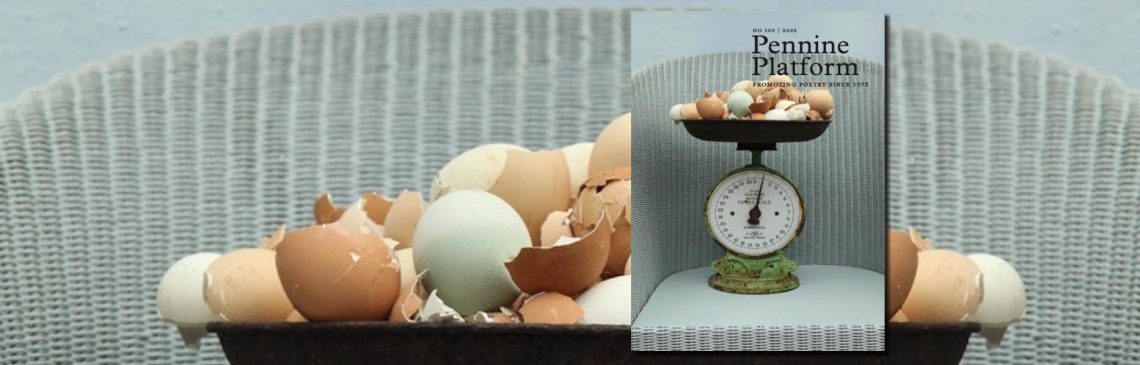

As this issue is numerically distinguished, let’s talk about metrics: the measurement of poems. Not least because there are some outstanding formal examples in these pages: a haiku sequence, a sestina, Spenserian stanzas and a sonnet. As readers, we know how a poem’s shape and sound can draw us in. Looking accessible and memorable, it signals skill on the poet’s part, perhaps borne out by emotional impact, whereas seemingly random words may daunt and disappoint. The trick is to allow for some play: not to be too doctrinaire as readers or poets.
Robert Herrick’s seventeenth-century poem ‘Delight in Disorder’ conjures the image of a slightly dishevelled woman in admiring detail, before making this a case for art in general. A ‘careless shoestring’ completes the look in which the poet sees a ‘wild civility’ (not so wild, then) more bewitching ‘than when art/is too precise in every part.’ But wait. The list is ordered from head to toe, the couplets rhyme, and deploy a near-perfect rising metre (iambic tetrameter). He has seduced us with technique. The crafty so-and-so.
Another Traitors candidate, Marianne Moore, begins her 1919 poem ‘Poetry’: ‘I too dislike it: there are things that are important beyond all this fiddle.’ A relentless pruner herself, she successively cut this down from a fiendishly self-imposed six-stanza syllabic pattern to three lines. By 1967 she apparently still disliked poetry, but seems to have enjoyed the fiddle. Anne Carson spent a year studying Greek metrics before developing the groundbreaking oeuvre which earned her Nobel Prize. Moore’s poems, and many of Carson’s, such as her well known ‘Father’s Old Blue Cardigan’
sometimes look like free verse because the lines exceed the page width. A wider page would show its arrangement in tercets, and analysis of the scansion would show a high proportion of stressed syllables, adding sonority.
While free verse is often more formal than it looks, closed forms can be judiciously modified, like the painter Louise Giovanelli’s spectacular curtain canvasses, where she deliberately introduces a barely perceptible ‘flaw’. And both routes can lead in unexpectedly fruitful directions. We can’t all walk round the world like Karl Bushby, who recently returned from his 28-year odyssey, not to Ithaca, but Hull. ‘I always say 99.999% of the people I met represented the very best of humanity. Every country has been the same,’ he said. That’s one way of reshaping one’s world view. Poems are another.
Julia Deakin
October 2026

